
Cash for Reentry
Despite having served their time, formerly incarcerated individuals face a host of structural and social challenges reintegrating. We believe that providing repeat, unconditional financial support gives people the autonomy and dignity to make decision for themselves about how they rebuild their lives.
Recurring cash transfers support the stability necessary for individuals to pursue and achieve their personal goals – be they related to housing, employment, relationships, mental and/or physical health. We follow the journeys of these varied groups of individuals, learning critical insights into improving economic and social support for communities most impacted by mass incarceration.

New Haven, Connecticut
Mar 2023 - Oct 2025
Sixty formerly incarcerated individuals from the New Haven area received $500/month for 12 months in Connecticut’s first guaranteed income pilot.
The pilot, developed in partnership with the Project M.O.R.E. Reentry Welcome Center and the City of New Haven, is part of a larger effort to address the cycle of recidivism and reduce community violence in New Haven.
New York, New York
Feb - Jul 2026
Twenty-five New York City families are receiving $1,000/ month for 6 months as part of a cash transfer pilot designed by New York University School of Law students to address the effect of mass incarceration on parents and children.
To carry out the pilot, the students in NYU Law’s Basic Income Lab have partnered with the Center for Employment Opportunities. The program is administered by 4-CT as part of 4-CT’s ongoing collaboration with the NYU Law Basic Income Lab.

More than 95% of those currently in prison will be released, and 26%-32% of those will be reincarcerated within one year.

High rate of incarceration in the U.S., which are disproportionately experienced by Black, Indigenous, and low-income individuals, result in a massive health toll (mental and physical) on incarcerated individuals and reverberate to their families and communities.

Although services exist, outcomes are often poor because of unmet proximate needs.

Government policies like the Work Opportunity Tax Credit, which provides subsidies for employers who hire formerly incarcerated people, acknowledge that financial stability is critical to successful reentry. However, even with such programs, only up to 55% of incarcerated adults are employed in the four years immediately following release.
-
Number of participants: 60
Population focus: Individuals returning from prison to a New Haven City or County address
Age range: 19-74
Race/ethnicity: 85% Black, 12.5% hispanic, 2.5% Multiracial
Avg. monthly income: $1,590
Sentence length range: 6 months - 30+ years
-
Participants are selected by the Project M.O.R.E. Reentry Welcome Center.
-
Demonstrate the benefits of a guaranteed income for formerly incarcerated individuals.
Improve systems for delivering support to individuals reentering the community.
Better understand the context of trauma in the lived experiences of justice-impacted individuals.
-
Each participant receives $500 of unconditional cash assistance each month for 12 months on a card that combines New Haven’s Elm City ID + prepaid Mastercard, developed in partnership with the City of New Haven, Mastercard’s Global Cities team and Usio.
-
4-CT provides the cash assistance, which is funded entirely through philanthropy.
-
Through quarterly interviews, surveys and analysis of spend data, 4-CT is evaluating the impact of the cash assistance on the employment status, housing security, family relationships, community engagement, mental health and recidivism rate of participants.
CT Pilot Overview
-
Number of participants: 25
Population focus: Individuals who were incarcerated within the last 12 months and have at least one child under the age of 18.
-
Participants are individuals who enrolled in the Center for Employment Opportunities’ job-readiness training program and are returning to their families after a period of incarceration
-
Examine how direct cash transfers affect families facing hardship.
Increase financial security and reduce economic stress.
Better understand the effect of mass incarceration on parents and children.
-
Each participant receives $1,000 of unconditional cash assistance each month for 6 months on a prepaid Mastercard.
-
4-CT , through private philanthropy, funded the pilot which runs from February to July 2026.
-
Through interviews and surveys, 4-CT and the NYU Law Basic Income Lab are evaluating the impact of the cash transfers on the employment status, housing security, family relationships, community engagement, and mental health of participants.
NY Pilot Overview

BASIC INCOME PILOT FOR JUSTICE-IMPACTED PARENTS LAUNCHED

CASH TRANSFER PILOT READIES 3RD COHORT

ELM CITY REENTRY PILOT PANEL DISCUSSION
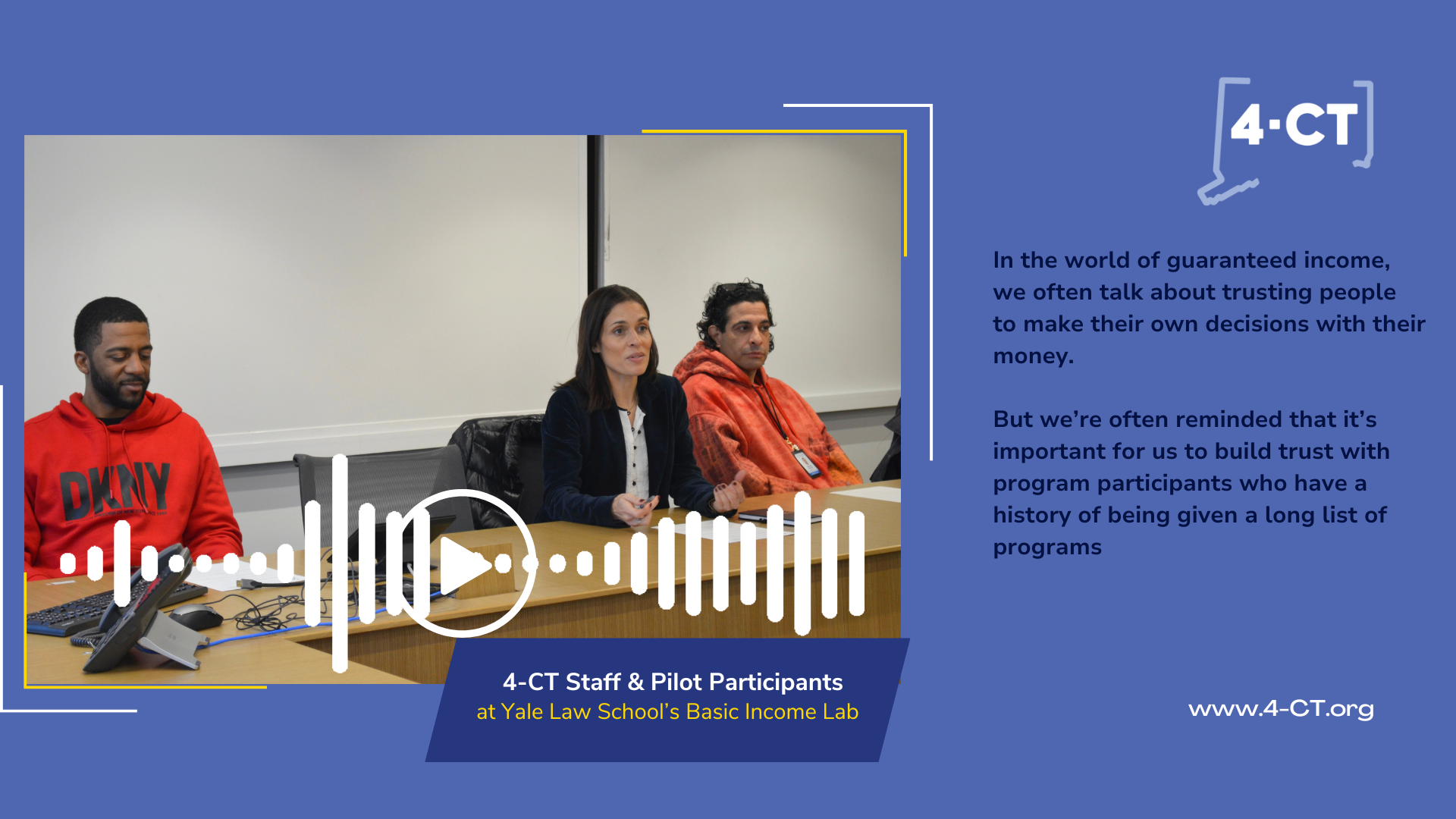
4-CT GUEST LECTURE AT YALE LAW SCHOOL'S BASIC INCOME LAB

CONNECTICUT PUBLIC INTERVIEWS 4-CT CEO SARAH BLANTON

ROLLING BOULDERS UPHILL: RETHINKING REENTRY WAGE AND POLICY BARRIERS WILL BENEFIT CONNECTICUT'S COMMUNITIES AND ECONOMY
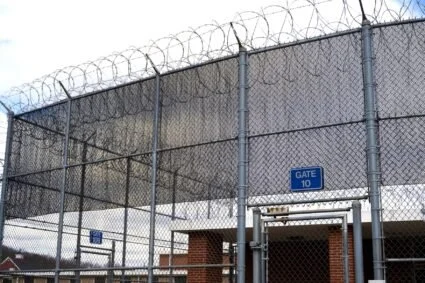
NEW HAVEN BETS NO STRINGS ATTACHED $500 MONTHLY PAYMENT WILL LOWER RECIDIVISM
PROGRAM LAUNCHED IN NEW HAVEN TO HELP THOSE RELEASED FROM PRISON

PROGRAMA BUSCA BRINDAR NUEVAS OPORTUNIDADES A EX-RECLUSOS

'IT COULD BE A LIFESAVER' | NEW HAVEN PILOT PROGRAM WORKING TO REDUCE RECIDIVISM

PRISON REENTRY PILOT PROGRAM GIVES PARTICIPANTS $500 PER MONTH
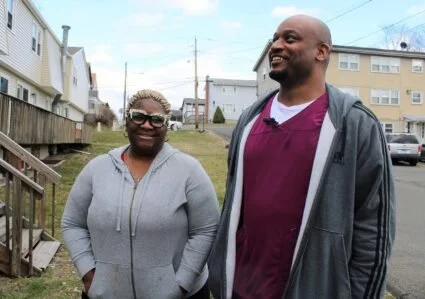
REENTRY PILOT TESTS $500 CASH TRANSFERS

PILOT PROGRAM HOPES TO HELP FORMERLY INCARCERATED INDIVIDUALS IN CONNECTICUT